

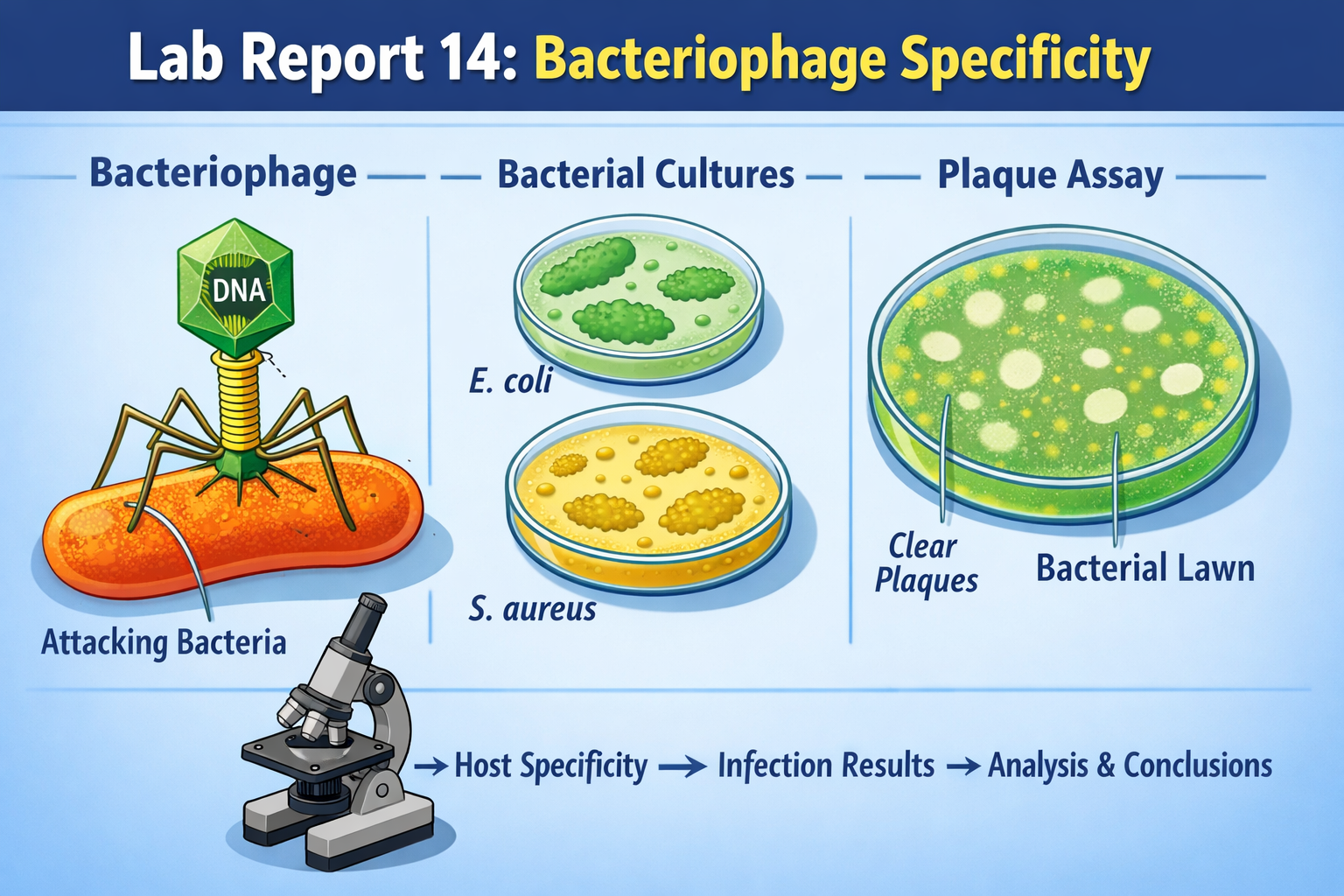
Lab Report 14 Bacteriophage Specificity is an important topic for students studying microbiology, biology, or laboratory sciences. It focuses on how bacteriophages interact with bacterial cells and why certain viruses infect only specific bacterial hosts under controlled laboratory conditions.
This subject is useful because it connects theory with real lab observations. Students learn how to recognize patterns of infection, record plaque formation, and explain why some bacterial strains are affected while others remain unchanged during the same experiment.
What Is a Bacteriophage?
A bacteriophage, often called a phage, is a virus that infects bacteria. Unlike viruses that infect plants, animals, or humans, bacteriophages are specialized particles designed to attach to bacterial cells and use them for reproduction and survival.
These tiny biological agents are found almost everywhere, including soil, water, and the human body. In laboratory studies, bacteriophages are important because they help researchers understand bacterial behavior, viral infection, and possible future uses in medicine and biotechnology.
Understanding Bacteriophage Specificity
Bacteriophage specificity refers to the ability of a phage to infect only certain types of bacteria. A phage may attack one bacterial species, one strain, or a small group of related bacteria while failing to infect others present in the same environment.
This specificity happens because phages recognize particular receptors on bacterial surfaces. If the receptor matches the phage structure, infection can begin. If the receptor is missing or different, the phage cannot attach properly, and no infection takes place.
Purpose of Lab Report 14 Bacteriophage Specificity
The main purpose of Lab Report 14 Bacteriophage Specificity is to study which bacteriophages infect which bacterial hosts. This allows students to understand host range, infection patterns, and the biological selectivity that makes phages unique among microorganisms.
The experiment also teaches observation, analysis, and scientific reporting. Students do not simply perform a procedure; they learn how to describe results, compare reactions between test samples, and explain why a phage shows activity against one bacterium but not another.
Materials Used in Lab Report 14 Bacteriophage Specificity
Common materials in this experiment include agar plates, sterile loops, pipettes, bacterial cultures, bacteriophage samples, nutrient broth, and incubators. Each tool supports a controlled method for testing infection and observing whether phage activity produces visible changes on bacterial lawns.
Agar plates provide the surface where bacteria grow, while phage samples are introduced to test possible infection. Pipettes and sterile instruments reduce contamination, and incubators maintain the conditions needed for both bacterial growth and bacteriophage action during observation.
Procedure for Lab Report 14 Bacteriophage Specificity
The procedure usually begins by preparing bacterial lawns on agar plates. A uniform layer of bacteria is spread across the medium so that any phage activity becomes visible after incubation. This creates a suitable environment for identifying infection zones clearly.
Next, phage samples are applied to selected areas, and the plates are incubated for a set time. After incubation, students examine the plates for plaques, measure visible effects, record patterns, and compare reactions among different bacterial cultures.
How Plaques Show Bacteriophage Specificity
Plaques are clear or cloudy zones that appear where bacteriophages have infected and destroyed bacterial cells. These areas are important evidence in Lab Report 14 Bacteriophage Specificity because they show where a phage successfully attached, multiplied, and lysed bacteria.
If plaques form on one bacterial lawn but not on another, this suggests host specificity. The phage is effective against one bacterial type but not the other. This visual difference helps students identify the host range and interpret phage behavior accurately.
Observations Recorded in Lab Report 14 Bacteriophage Specificity
A strong lab report includes detailed observations such as plaque size, number, shape, and clarity. Students may also note bacterial growth density, contamination signs, and whether the lysis pattern is complete, partial, or absent on each test plate.
Careful observation improves the scientific value of the report. Rather than writing only that plaques appeared, students should explain how many were seen, where they formed, and what differences existed between bacterial samples tested under the same conditions.
Results and Interpretation
Results in Lab Report 14 Bacteriophage Specificity should be presented clearly and logically. Tables, labeled diagrams, and short written summaries help organize findings. A positive result usually means infection occurred, while a negative result suggests the bacterium resisted or lacked compatibility.
Interpretation is just as important as the raw data. Students should explain what the results mean in relation to host specificity. If one bacteriophage produced plaques only on selected bacteria, the report should connect that pattern to receptor recognition and host range.
Factors That Affect Bacteriophage Specificity
Several factors can influence bacteriophage specificity, including the structure of the phage tail fibers, the type of bacterial surface receptor, environmental conditions, and genetic mutations. Even small biological differences can change whether infection succeeds or fails in the lab.
Temperature, nutrient availability, and bacterial growth phase also affect results. A phage may be capable of infecting a host, but poor experimental conditions can hide or reduce visible evidence. That is why controlled methods are essential for reliable interpretation.
Importance of Lab Report 14 Bacteriophage Specificity in Microbiology
This topic is important in microbiology because it explains how viruses and bacteria interact with remarkable precision. Understanding these relationships helps students see that infection is not random. Instead, phage activity depends on biological compatibility between the virus and host.
Bacteriophage specificity also has practical value beyond the classroom. It supports research in bacterial control, food safety, molecular biology, and phage therapy. By studying this concept, students gain knowledge connected to both academic science and future medical innovation.
Common Mistakes in Writing Lab Report 14 Bacteriophage Specificity
One common mistake is giving weak observations without enough detail. Students may write that results were positive or negative without describing plaque appearance, sample differences, or bacterial response. This reduces the clarity and scientific strength of the entire report.
Another mistake is drawing conclusions that do not match the data. Good reporting requires careful comparison between evidence and explanation. Clear formatting, correct terminology, and accurate interpretation help make Lab Report 14 Bacteriophage Specificity more professional and academically sound.
Conclusion
Lab Report 14 Bacteriophage Specificity helps students understand one of the most fascinating ideas in microbiology: not every virus can infect every bacterium. The experiment demonstrates how specific biological recognition leads to infection, plaque formation, and measurable laboratory outcomes.
In simple words, this lab report teaches observation, analysis, and scientific thinking. It also shows why bacteriophage specificity matters in research and real-world applications. For students, it is a valuable lesson in how precision shapes life at the microscopic level.
